Key facts: Sewer backup during heavy rain
- Most of Somerville is served by a combined sewer built in the late nineteenth and early twentieth centuries [1].
- Combined sewers carry sewage and stormwater together and can overflow during heavy rain [2].
- Somerville's long-term plan aims to eliminate combined sewer overflows in a typical year by the middle of the century [1].
- The city's Water and Sewer Department responds to emergency calls for sewer backups reported through 311 [3].
Short answer
Why do sewers back up into basements when it rains hard?
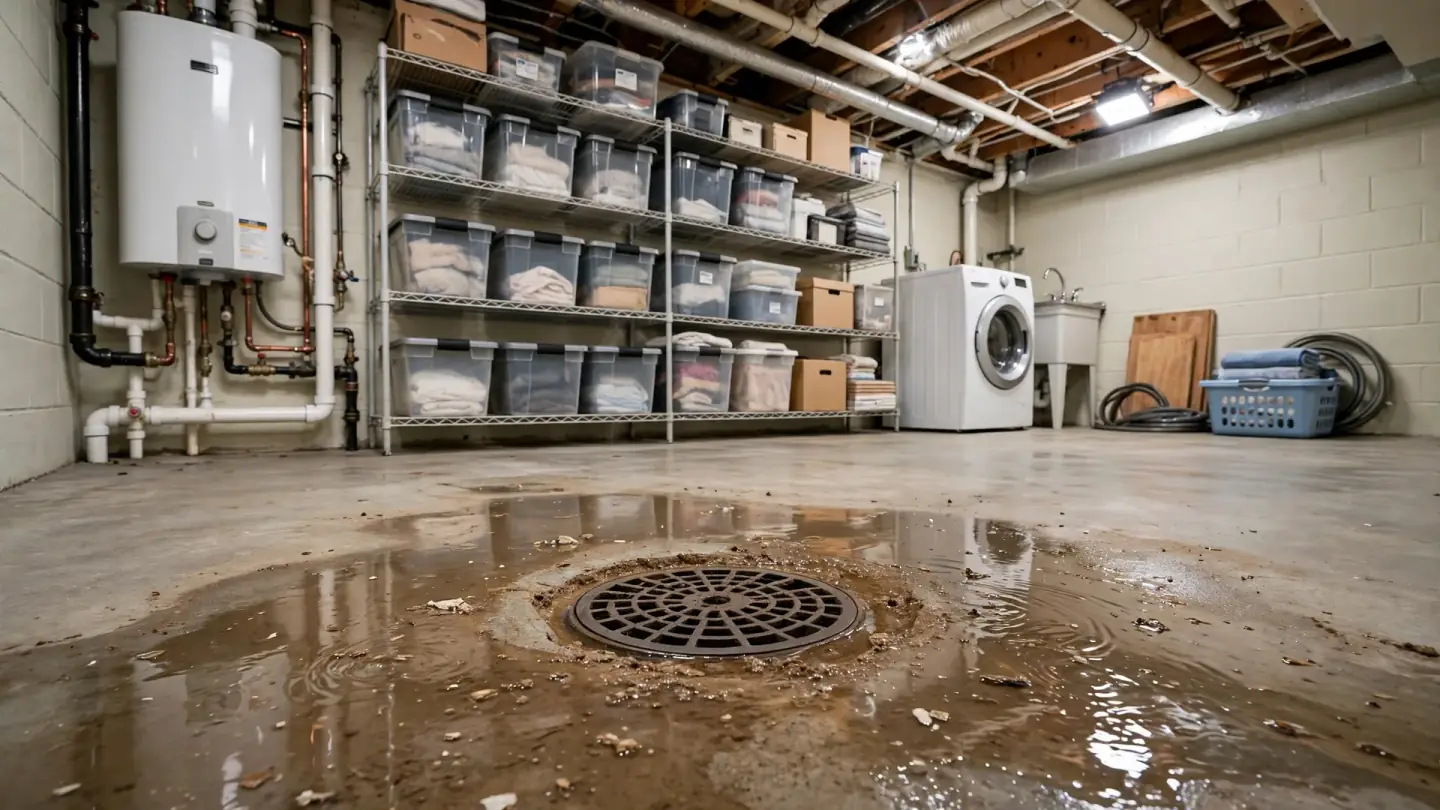
Most of Somerville drains into a combined sewer, one network of pipes that carries both household wastewater and rain running off roofs and streets [1]. On a normal day that flow travels toward the MWRA's Deer Island plant. In a cloudburst the same pipes can fill completely. Once the street sewer is running full, water has nowhere to go but back up the private laterals that feed it, and it surfaces at the lowest drain in each building [2].
That is why a storm backup can hit a house whose own pipes are perfectly clear. It is also why a lateral that is already narrowed by roots or grease tends to fail first, since it has less room to absorb the surge.
During the storm
Storm-time drain behavior and what each pattern suggests
| What you see | Likely cause | What to do |
|---|---|---|
| Floor drain bubbles or rises as the rain intensifies | Street sewer surcharging | Stop using water and watch the level |
| Water rises, then falls once the rain eases | Temporary surcharge in the combined system | Clean up, then report it to 311 |
| Water stays high long after the storm | Private lateral also partly blocked | Call about clearing the line |
| Downspout water pooling at the foundation | Roof runoff with nowhere to go | Redirect it away from the house |
| Street catch basin flooded or covered in leaves | Blocked storm inlet | Report it through 311 |

Before the rain
Getting a Somerville cellar ready the day before a big storm
- Lift anything that cannot get wetMove boxes, rugs and electronics off the cellar floor, especially near the floor drain.
- Clear the catch basin out frontIf it is safe, rake leaves off the grate. The city also cleans catch basins and takes reports through 311 [3].
- Check downspouts and guttersMake sure roof water lands away from the foundation, so the house is not adding to the flow at the worst moment [4].
- Agree on a pause with the other unitsIn a two-family or triple-decker, ask neighbors to hold off on laundry and long showers while the heaviest rain falls.
- Know where the main shutoff and cleanout areThe sewer cleanout guide shows where to look before you need it.
The city's plan
What Somerville is doing about combined sewer overflows
Somerville has a permitted overflow outfall to Alewife Brook and shares a permit for one on the Mystic River. Its long-term control plan aims to eliminate overflows in a typical year by the middle of the century, with work that includes a storage tank in Assembly Square and sewer separation in Ten Hills and Winter Hill [1]. Separation means building separate pipes for stormwater so rain no longer fills the sewer meant for household waste.
That work happens over years. In the meantime, owners on streets still served by combined pipes can expect that a severe storm may push water toward their cellars, and preparation at the house level still matters.
Who handles what
Which parts of a storm backup the city handles and which the owner does
The Water and Sewer Department maintains public sewers, pump stations and catch basins, and responds to emergency backup calls [3]. If the street sewer is the problem, reporting it gives the city a record and a chance to check its main. Ask the department where private responsibility ends on your street rather than assuming.
Inside the property line, the building drain, the private lateral, the floor drain, and any backwater valve are the owner's to maintain. A drain contractor can clear a private line, and a licensed plumber handles repairs or installs that need a permit [5].
Making it less likely
Can a backwater valve or a clean lateral stop storm backups?
A backwater valve closes when water flows from the street toward the house, and in many buildings it is the most direct protection against surcharge. It has to suit the plumbing layout and needs periodic checks; the backwater valves explained guide covers the details.
A clean lateral helps too. A line that is partly blocked by roots or grease has less spare room, so periodic main sewer line cleaning and a camera check can reduce how often a storm tips it over.
Afterward
How a drain contractor checks a line after a storm backup
- 1
Asking when the water rose and fell
Water that drained away as the rain ended points to the street; water that stayed points to a private blockage.
- 2
Running water to test the line
Once the storm has passed, fixtures are run to see whether the floor drain still rises.
- 3
Clearing any blockage found
If the line is slow, a cable or jetter opens it toward the street.
- 4
Inspecting with a camera
Roots, sags and broken joints that make storm backups worse show up on camera.
- 5
Talking through protection
The contractor may suggest a backwater valve, which is permit work for a licensed plumber.
Prevention
Longer-term habits for houses on Somerville's combined sewer
- Keep grease and wipes out year-roundA lateral narrowed by grease fails sooner in a storm. The what not to pour down drains list applies.
- Store things off the cellar floorShelving and sealed bins make a minor surge an inconvenience rather than a loss.
- Keep an eye on the city's planThe overflow control plan page lists the projects affecting different neighborhoods.
On the call
Storm backup details to tell the contractor
- When it started and stoppedWhether the water rose with the rain and fell after it.
- Whether neighbors had it tooStreet-wide problems point toward the city sewer.
- What drains are in the cellarFloor drain, laundry tub, toilet or shower.
- Whether you reported it to 311And anything the city told you about its main.
Rain and sewers
Heavy rain sewer backup questions for Somerville owners
Why does my basement only flood with sewer water when it rains?
Most of Somerville has combined sewers that carry rainwater and sewage in the same pipes. In heavy rain they can run full and push water back up into the lowest drain in your building.
What should I do before a big storm to protect my cellar?
Lift belongings off the floor, clear leaves from the catch basin if safe, point downspouts away from the house, and ask the other units to hold off on heavy water use while the worst rain falls.
Is a storm sewer backup the city's fault or mine?
It can be either. A surcharging street sewer is the city's system, while your building drain and lateral are private. Report street problems to 311 and ask the city where private responsibility ends on your street.
When will Somerville stop having combined sewer overflows?
The city's long-term plan aims to eliminate overflows in a typical year by the middle of the century, through projects like a storage tank in Assembly Square and sewer separation in Ten Hills and Winter Hill.
Should I run a sump pump into the floor drain during a storm?
Ask a plumber first. Pumping groundwater into a drain that is already backing up from the street adds water to a full system. A contractor can advise where pumped water should go.
Can I use my washing machine while it's pouring outside?
It is wiser to wait. A full load sends a lot of water into a line that may already be pushing back. Do laundry once the rain has eased and the floor drain is quiet.