
Key facts: Drain Camera Inspection
- A building's drain-waste-vent system ties every fixture to vertical stacks and a building drain, so a camera can often reach a problem from more than one opening [1].
- Cast-iron drain pipe corrodes and builds scale on its inner wall over time, which a camera shows as rough, narrowed or flaking pipe [2].
- Clearing a stoppage does not need a plumbing permit in Massachusetts, but altering, replacing or repairing pipe does [4].
- Triple-deckers stack three flats over each other, so upper units often drain through a shared stack that serves the floors below [5].
The tool itself
How a push camera travels through a Somerville drain line
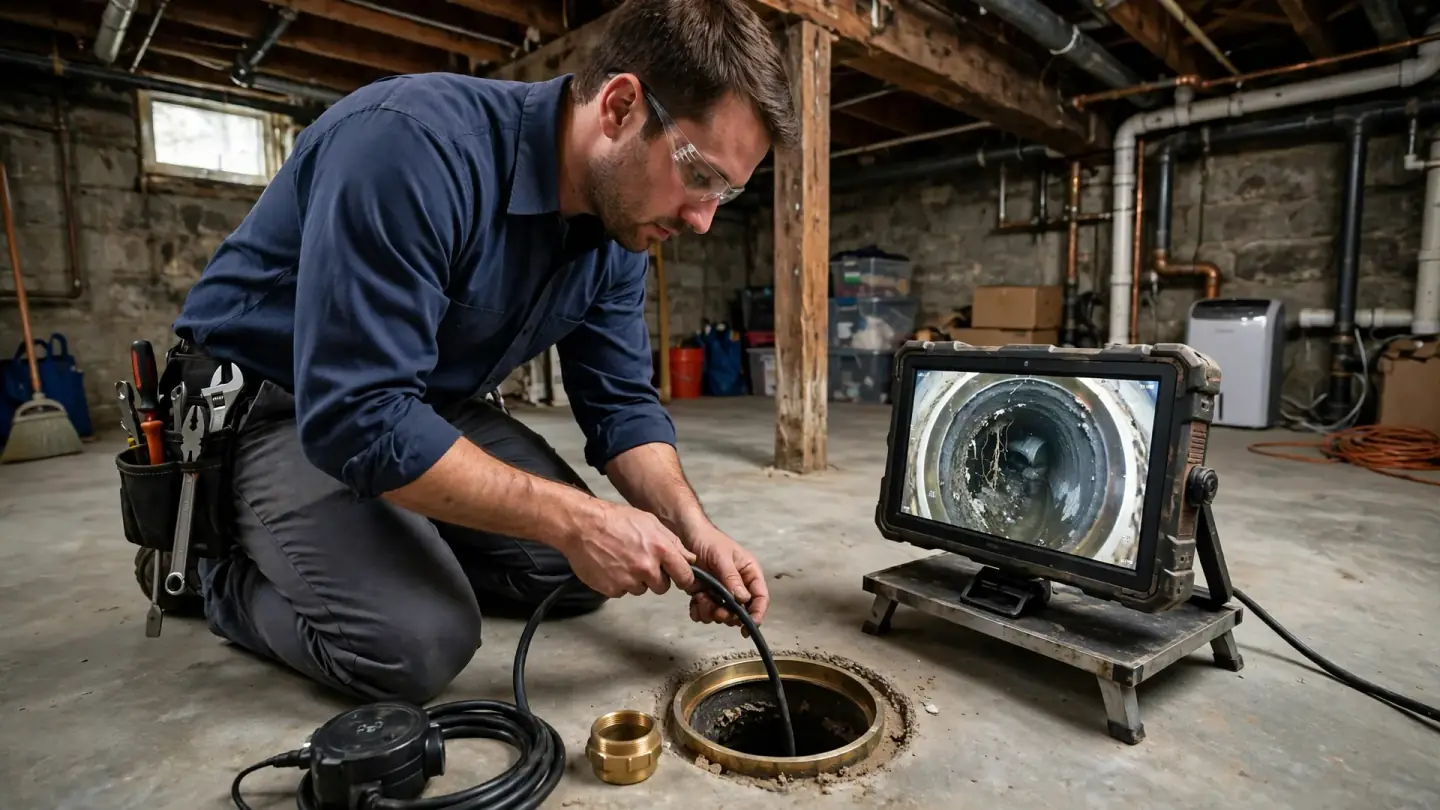
An inspection camera is a sealed lens and a ring of small lights at the tip of a semi-rigid fiberglass rod. The rod lives on a reel, and the contractor feeds it into the pipe by hand, a foot at a time, while a monitor shows the view from the head. A counter on the reel tracks how far the camera has gone. A self-leveling head keeps the image upright, so a belly in the line or a sag full of standing water looks like what it is rather than a confusing spin.
Smaller heads fit interior branch lines, such as the inch-and-a-half drain from a kitchen sink or a bathroom group. Larger heads on stiffer rods suit the three- and four-inch stacks and building drains found in the basement. The contractor picks the size to match the pipe, because a head that is too big will jam at the first fitting, and one that is too small can flop around in a wide pipe and give a poor view.
Getting in is half the job. The camera can go through a cleanout plug, through a sink trap once the trap is taken off, through a roof vent on a stack, or through a toilet flange with the toilet pulled. Every building's drain-waste-vent layout is different, and a single pipe can usually be reached from more than one opening [1]. Which one makes sense depends on where the trouble seems to be and how many bends the camera must turn to get there.
Most cameras also carry a small radio transmitter, called a sonde, just behind the lens. Above ground, a handheld receiver picks up that signal and shows where the head is and roughly how deep. That turns a picture of a crack into a spot on the floor, a wall, or a ceiling, which is what someone actually needs before opening anything up.
Reasons to look
When is a drain camera inspection worth it?
A camera is not the first step for every slow sink. These are the patterns where seeing inside tends to pay off.
The same branch line clogs every few months
Repeat clogs on one line point to something in the pipe catching debris. A camera finds the ledge, sag or broken joint that keeps doing it.
Gurgling from one fixture when another drains
Air being pulled through a trap can mean a partial blockage or a vent problem. The guide to gurgling drains walks through the causes.
Read moreWater appearing in a lower unit after an upstairs drain runs
In stacked flats this often traces to a shared stack. The triple-decker drain stack guide explains the layout.
Read moreA sewer smell near a wall or in the basement
A cracked fitting or a dry trap can let sewer gas in. The basement sewer smell guide covers what to check first.
Read morePlanning a kitchen or bath renovation
Before new cabinets or tile go in over an old drain, a look inside can show whether the pipe should be replaced while the walls are open.
On the day
What a typical camera visit on a Somerville interior drain looks like
Every visit is shaped by the building, but the order of work tends to follow this pattern.
- 1
Talking through the history of the line
The contractor asks which fixtures are slow, how often, whether anything changed recently, and who lives above or below. In a two-family or triple-decker, that conversation often narrows the search to one stack before any tool comes out.
- 2
Choosing the access point and head size
Next comes picking the opening closest to the suspected trouble with the fewest bends between. A kitchen branch may be entered at the sink; a stack may be entered from a basement cleanout or from the roof.
- 3
Clearing enough to see
If the pipe is full of standing water or packed with debris, the camera shows nothing useful. A cable or jet may open the line first so the lens has a clear view of the wall.
- 4
Running the camera and narrating the footage
The rod is fed slowly while the contractor points out fittings, joints, scale, offsets and any cracks. You are welcome to watch the monitor and ask what you are looking at.
- 5
Locating anything worth marking
Where the footage shows a defect, the sonde is switched on and the receiver used to mark that spot on a floor, wall or ceiling, along with an approximate depth.
- 6
Keeping the recording and explaining the options
Many cameras save video with the footage counter on screen. Ask for a copy. It helps if you want a second opinion, need to show a condo board, or are deciding between cleaning and repair.
Reading the screen
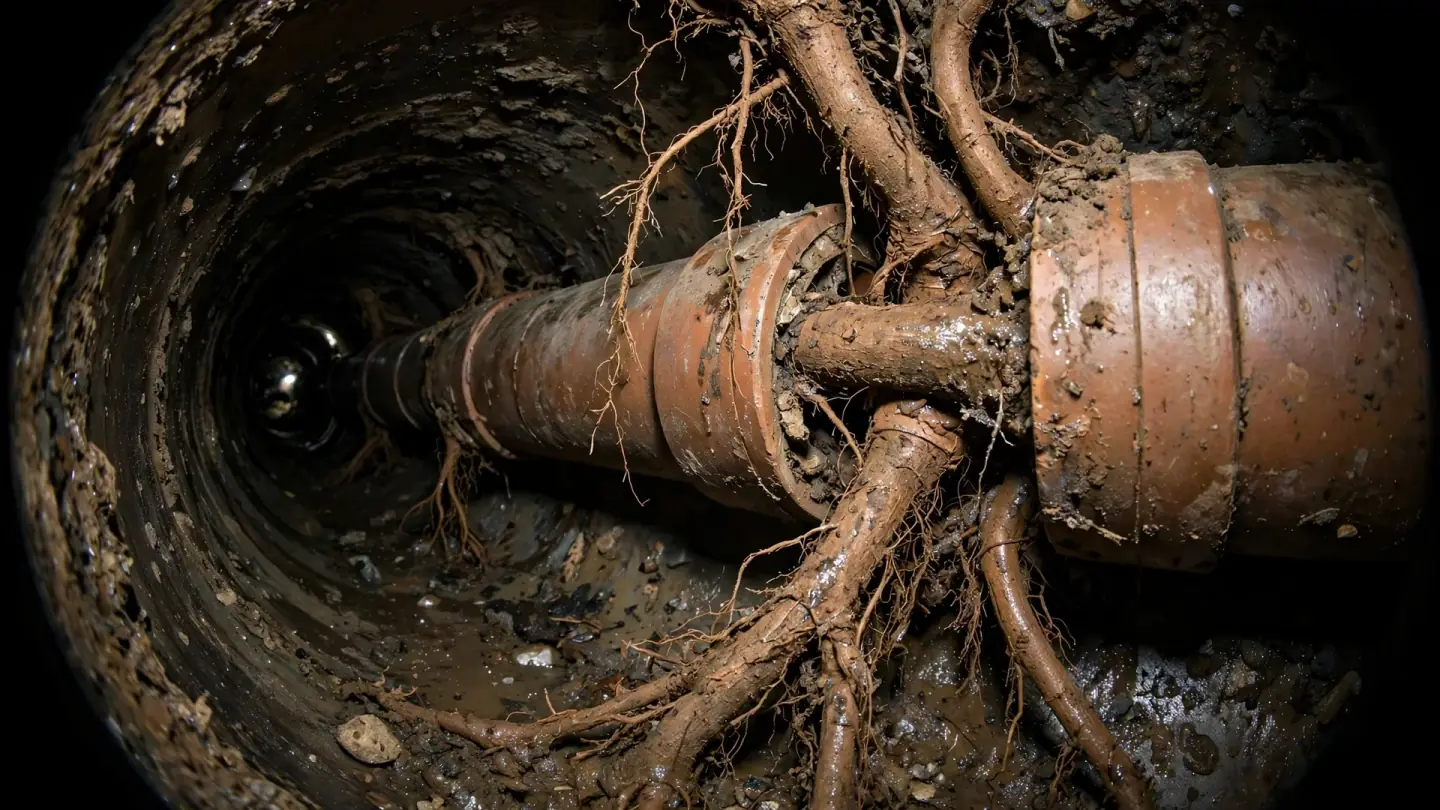
What does a drain camera actually show inside old pipes?
Footage can be hard to read the first time. These are the conditions that come up most in older houses, and what each one usually leads to.
| What the screen shows | What it usually means | Typical next step |
|---|---|---|
| Rough, bumpy wall with orange or dark crust | Scale and corrosion inside older cast-iron pipe [2] | Gentle descaling where the pipe is still sound; replacement talk if the wall is thin |
| Grey, soft coating that smears when touched | Grease and soap residue, common on kitchen branches | Cleaning, often by jetting, plus changes at the sink |
| Standing water that stays level for several feet | A belly or sag where the pipe has dropped | Cleaning helps briefly; a sag usually needs repair to stop repeating |
| Hairline line running along the pipe | A crack, sometimes along the bottom where water sits | Monitor or repair depending on length and whether it weeps |
| Fine roots at a joint on a basement line | Roots entering where clay or older pipe joins outside the wall [3] | Root cutting, then a look at the lateral itself |
| Offset where one section sits higher than the next | A shifted joint that catches paper and debris | Repair at the joint, sometimes with spot replacement |
Interpreting footage is judgment, not a formula. Ask the contractor to pause on anything you do not understand.
Your part
Helping a Somerville camera inspection go well, and where to leave it alone
There is useful prep you can do, and a short list of things better left to the drain contractor on the call.
- Clear a path to every cleanoutMove storage boxes, bikes and laundry away from basement cleanouts, and empty the cabinet under any sink that may be opened.
- Write down the patternNote which fixtures misbehave, at what times, and whether rain or heavy laundry days seem to matter. Patterns save searching.
- Tell neighbors in shared buildingsIf the stack serves other units, ask them to hold off running water during the inspection so the view stays clear.
- Do not open a cleanout under pressureIf water is standing in a fixture above, a cleanout plug can release a rush of sewage. Leave that to the contractor.
- Skip chemical drain openers beforehandCaustic products can sit in the line and splash when a trap or cleanout is opened, and they do nothing for a cracked or sagging pipe.
- Do not run a rented camera into a stack aloneRental units can jam at fittings in old cast iron, and pulling a stuck head out hard can damage the pipe.
Local buildings
Camera work inside Somerville triple-deckers and two-families
Somerville filled in quickly through the early twentieth century, and a large share of its housing is still the stacked two- and three-family buildings of that period [6]. In a triple-decker the kitchens usually sit one above the other, and so do the bathrooms, which means a third-floor sink can drain through a stack that passes behind the walls of the two flats below [5]. When a clog shows up in the middle unit, the cause may be in a pipe that belongs to the building rather than to that apartment.
That shapes how a camera visit goes. The contractor may want to enter the stack from the basement and look upward, or from the roof vent and look down, rather than through any one tenant's sink. In a condo association, it helps to have someone with authority over common pipes on hand, because the recording often answers the question of whose line it is.
Many older Somerville homes still have cast-iron stacks and building drains, sometimes patched over the decades with newer plastic sections. Transitions between materials are a common place for an offset or a poor seal, and they show up clearly on camera. Basement drains in homes of this era may also connect to clay pipe just past the foundation, which is where a look at the sewer line inspection page becomes relevant.
If footage points to a defect in the exterior lateral or near the street, ask the city's Water and Sewer Department where private responsibility ends on your street before anyone plans digging.
Choosing the fix
When camera footage says cleaning will do and when it points to pipe repair
A good share of inspections end with reassuring news. The pipe is coated but intact, the joints are tight, and the clog was a buildup that cleaning removes. In that case the next step is kitchen drain cleaning or hydro jetting to restore the full bore, and some changes in habits so the coating does not come back as quickly.
Other footage tells a different story. A sag that holds water will keep collecting debris no matter how often it is cleaned. A crack that weeps, a joint that has pulled apart, or cast iron that has rotted through along the bottom will not be helped by more cleaning, and aggressive cleaning can make thin pipe worse.
In Massachusetts, clearing a stoppage is not permit work, but cutting out and replacing pipe is. That repair has to be done by a Massachusetts-licensed plumber under a permit from Somerville's plumbing inspector [4], and only those licensed by the state Board may do work within their license [7]. A recording from the inspection helps whoever does that repair plan it accurately.
If a drain is actively backing up right now, the camera can wait. Start with the emergency drain cleaning page and call to check emergency availability; the inspection can follow once the water is moving.
FAQ
Questions Somerville owners ask about drain camera inspection
Is a drain camera the same thing as a sewer line inspection?
The tool is similar, but the focus differs. A drain camera visit looks at interior branch lines, stacks and the building drain. A sewer line inspection looks at the lateral from the foundation out toward the street. Plenty of visits end up covering a bit of both.
Can the camera go up a stack from the basement?
Often it can, if there is a cleanout near the base and the bends are gentle. Some stacks are easier to inspect from the roof vent looking down. The contractor on the call can say which approach suits your building.
Will I get a copy of the video?
Many inspection cameras record, and many contractors will share the file. Ask about it on the call before the visit so they bring a way to save it. A copy is handy for landlords, condo boards and anyone getting a second opinion.
Does the drain need to be clear before the camera goes in?
Mostly, yes. A pipe full of standing water or packed debris shows nothing useful. The contractor may open the line with a cable or jet first, then run the camera to see what caused the blockage. Ask whether the contractor plans to clean first so the camera has a clear view.
Can the camera tell me exactly where to open a wall?
With the sonde transmitter behind the lens, the contractor can mark the spot on the surface and estimate depth. It is close, though not exact to the inch, so expect a little extra room when an opening is made. A locator can mark the camera head's position from outside, which narrows where an opening is needed.
How long does a drain camera inspection take?
A camera look at one interior drain is usually a short part of a visit. Time goes up if the line must be cleared first, if access is awkward, or if several stacks in a triple-decker are checked. The contractor you're connected with can estimate once they know how many lines need to be seen.
Can a drain camera find a leak behind a wall?
It can show cracks, open joints and separated pipe that may be leaking, but it does not see water outside the pipe. Stains and damage on the wall or ceiling tell the rest. Combined, they help pin down the spot. For the sewer lateral outside, see sewer line inspection, and the services hub lists related work.