
Key facts: Davis Square
- Davis Square was named in 1883 after Person Davis, a grain dealer, and grew from post-Civil War subdivisions in West Somerville [1].
- The Red Line station at Davis opened on December 8, 1984, and the square revived after it arrived [1].
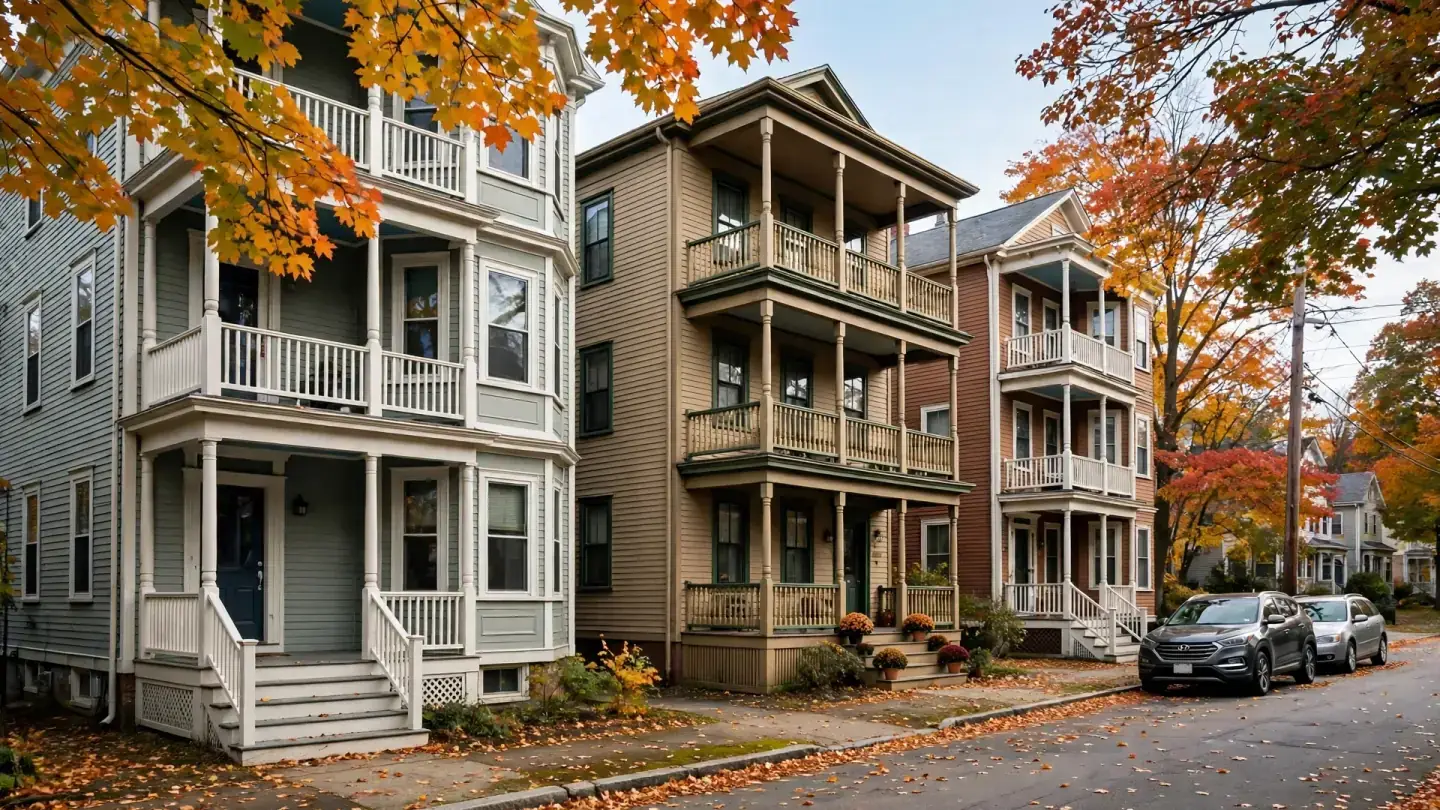
- Triple-deckers were built across New England from roughly the 1870s to the 1930s, stacking three flats over one another [3].
- Clearing a stoppage does not need a Massachusetts plumbing permit, but altering or replacing pipe does [4].
Housing around the square
What Davis Square houses are like from the basement up
The square took its name in 1883 from Person Davis, a grain dealer, at a time when West Somerville was being carved into house lots after the Civil War [1]. Most of the streets that radiate from the square, toward Ball Square, Powder House Square and Spring Hill, filled in over the following decades with gable-front two-families, single-family houses and, later, triple-deckers [1][3]. Somerville as a whole kept building homes through the 1940s, which is why the city is still described as a dense residential fabric [2].
From a drainage point of view, the typical Davis Square house is simple and tall. A cast-iron stack rises through the middle or the back of the building, collecting a kitchen and a bathroom on each floor. At the bottom it turns into a building drain that crosses the basement, often with a cleanout plug near the front wall, and leaves through the foundation toward the street sewer. In a three-family, everything the top floor sends down passes the second and first floors before it reaches the basement.
Basements around the square tend to be low and partly finished. Many hold a washing machine on a laundry sink or standpipe, a floor drain near the boiler, storage cages for each unit and, in some houses, a basement bedroom or rec room that was added later. Those added rooms matter, because a fixture near the basement floor is the lowest point in the system and is usually where a blocked building drain shows itself first.
Over a century of ownership, most of these houses have been partly re-plumbed. It is common for newer plastic branch lines to meet original iron at the stack, or for a renovated bathroom on one floor to sit above an untouched one on the next. A drain contractor working near Davis Square should expect a mix of materials in one building and plan the approach around that.
What contractors run into
Drain problems Davis Square houses of this era commonly have
Kitchen lines shared by stacked Davis Square units
Homes of this era commonly have kitchens stacked one above another, so grease and food from three households meet in one horizontal run near the basement.
Scaled cast-iron risers in older Davis Square walls
Original iron stacks build up rough scale on the inside over decades, which narrows the pipe and gives paper and grease something to catch on.
Basement fixtures that flood first near the square
Laundry sinks, floor drains and later basement bathrooms sit lowest, so they are where a blockage in the building drain first appears as dirty water.
Clay or iron laterals under Davis Square front yards
Many older Somerville homes leave the foundation through clay or iron pipe that can admit roots at joints or settle under a small front yard.
Rentals near Tufts
Tenant turnover and drains in Davis Square rentals near Tufts
Davis Square sits next to Tufts University, and the streets between the square and the campus carry a large share of rental units [1]. That shapes how drains are used. Apartments change hands every year or two, tenants bring their own habits, and nobody living in the building may know where the cleanout is or what was cleared last time.
A shared stack in a rental house is a small commons. One flat that rinses cooking fat into the sink, or flushes wipes labelled flushable, can slow a pipe that every unit depends on. The building's owner usually has to arrange the work, but the tenants are the ones who notice the gurgling tub or the water rising in the first-floor shower. It helps when there is one agreed way for tenants to report a slow drain early, before it becomes a backup.
For owners who manage a few apartments, a short note in each unit about what not to pour down drains does more than any cleaning product. Grease that goes down hot cools and hardens on the pipe wall further along, and wipes do not break apart the way toilet paper does, so both tend to show up together at the point where the stack turns horizontal.
Move-out and move-in weeks are worth thinking about too. Kitchens get emptied, freezers get defrosted and a lot of unwanted food goes into disposals and sinks at once. If a building has a history of slow kitchen drains, late summer is a sensible time to have the line looked at.
Shared stacks
Why does a Davis Square three-family back up on the first floor?
In a stacked house the drain system works like a single trunk with branches at each floor. Water from the third-floor kitchen falls down the stack, turns at the bottom and runs along the building drain to the street. If the blockage is in that horizontal run, the water has nowhere to go but back up, and it comes out of the lowest opening it can find. That is why the first-floor tenant often sees the problem caused by the people upstairs.
A blockage in a branch is different. If only one bathroom sink or one kitchen is slow, the clog is probably in the trap or the short pipe between that fixture and the stack, and the other units are unaffected. Telling the two apart is the first thing a drain contractor on the call will ask about, so it helps to check every floor before you phone. The guide to triple-decker shared drain stack clogs walks through the signs floor by floor.
Vents matter as well. Each fixture's trap holds water to keep sewer gas out, and the vent lets air into the system so draining water does not pull those traps dry. When a stack is partly blocked, the rushing water can siphon traps on lower floors, which is why a gurgle in a first-floor sink can be the earliest sign of a problem somewhere else in the building.
Where the problem is
Reading the symptoms in a Davis Square multi-family
| What you notice | Likely location | Usual first step |
|---|---|---|
| One sink slow, everything else fine | That fixture's trap or branch | Clear the branch from the fixture |
| First-floor tub fills when upstairs drains | Building drain or base of stack | Open the basement cleanout and clear the main run |
| Basement floor drain overflows during laundry | Building drain or lateral to the street | Machine the main line, then consider a camera |
| Gurgling on several floors | Partial stack blockage or vent trouble | Check the stack and roof vent |
| Repeated clogs every few months | Scale, roots or a sag | Ask for a drain camera inspection |
The Red Line era
Davis Square after the Red Line: renovations and added fixtures
The square struggled after the Second World War and came back after the Red Line station opened on December 8, 1984 [1]. The renewed demand for housing near the station led to decades of renovation. Kitchens were opened up, second bathrooms were squeezed into old pantries, and many basements gained a laundry room or living space.
Each of those changes added flow to drains that were laid out for fewer fixtures. A second bathroom tied into an existing branch at a shallow angle, or a basement shower draining through a pump, can be the spot where trouble starts. When a contractor runs a camera, it is often a renovation connection rather than the original iron that turns out to be the weak point.
If you are planning work on a house near the square, it is worth having the building drain looked at while the walls and floors are open. Replacing a corroded section is far easier during a renovation than after the new tile is down, and any pipe replacement in Massachusetts is permit work for a licensed plumber [4].
Permits and boundaries
Do Davis Square drain jobs need a permit, and from which city?
Drain clearing and plumbing repair are treated differently under Massachusetts rules, and Davis Square sits close to another city.
- Clearing a Davis Square stoppage needs no permitUnder 248 CMR 3.05, the clearance of a stoppage is exempt from the plumbing permit requirement, so snaking or jetting a clogged line is not permit work [4].
- Pipe replacement goes through Somerville Inspectional ServicesCutting out and replacing pipe, adding a cleanout or installing a backwater valve is plumbing work that needs a Massachusetts-licensed plumber and a permit from Somerville's plumbing inspector [4][5].
- Licensed people and licensed businessesPlumbing work must be done within the scope of a Board license, apprentices must be licensed too, and plumbing companies need a business license [6].
- Addresses just over the line in Cambridge or MedfordSome streets near Tufts and the square cross into neighboring cities; an address in Cambridge or Medford is handled by that city's own plumbing inspector, not Somerville's.
- City sewer questions in Davis SquareIf the problem appears to be in the public sewer, Somerville residents can report water and sewer problems through 311 [5].
Planning a visit
Getting a drain contractor into a Davis Square house
Parking is the first practical question. Streets around the square are narrow and lined with permit-only resident parking, and a service van with a drain machine or jetter needs somewhere close to the door. Ask the contractor on the call what they need, and if you have a driveway space or know a nearby spot that is usually free, say so.
Access to the basement is the second. In many two- and three-families the basement is shared, entered from a back door or a bulkhead, and full of tenants' storage. Clearing a path to the cleanout, the floor drain and the laundry sink before the visit makes the work quicker and keeps belongings out of the way of a wet cable.
In a rental, coordinate with the other units. Ask everyone to hold off on showers, laundry and dishwashers while the line is being worked on, and make sure someone can let the contractor into each apartment if a fixture upstairs needs to be checked. Under the usual arrangement the owner books and approves the work, so tenants should loop in the landlord early.
Before you call
Five checks before calling about a Davis Square drain
- 1
Walk every floor of the Davis Square building
Note which fixtures are slow and which are fine; it tells the contractor whether the problem is a branch or the main line.
- 2
Look at the lowest drain in the basement
Water around a floor drain or in the laundry sink usually means the building drain or lateral is blocked.
- 3
Find the cleanout plug
It is often a round cap on the iron pipe near the front foundation wall; knowing where it is saves time.
- 4
Ask each Davis Square unit to pause water
Ask other households to pause showers, laundry and dishwashers so the backup does not get worse.
- 5
Write down what happened last time
If the line was cleared before, the date and what came out help decide whether a camera look is worthwhile.
FAQ
Davis Square drain questions from owners and tenants
Who pays for a clogged stack in a Davis Square rental?
Usually the owner arranges and pays for a stack clog, though your lease and the cause decide it in the end. The stack serves every unit, so owners tend to handle it as building upkeep. Tenants help most by reporting a slow tub or sink early, before a partial blockage turns into water rising on the first floor.
Why does my first-floor tub fill up when upstairs neighbors shower?
Their shower water is meeting a blockage below you. It runs down the shared stack into the horizontal building drain, and when that run is clogged, water climbs out of the lowest opening it can reach. In a Davis Square three-family that is often the first-floor tub, so the fix usually starts at the basement cleanout.
Do I need a permit to have a Davis Square drain snaked?
No, clearing a stoppage is exempt from Massachusetts plumbing permits. That covers snaking and jetting. If the contractor finds a cracked section that must be cut out and replaced, the job becomes permit work, and only a licensed plumber can pull that permit from Somerville Inspectional Services before the repair goes ahead.
My building straddles the Cambridge line. Which inspector applies?
The property's street address decides which city's inspector handles any permit. Houses near Davis Square with a Cambridge or Medford address go through that city, while a Somerville address goes through Somerville Inspectional Services. If you are unsure, the tax bill or deed shows the city, and the contractor will ask on the call.
Is a camera inspection worth it for a Davis Square house that keeps clogging?
Yes, if the same line clogs again within a few months. A camera run shows whether scale in old cast iron, roots at a clay joint, a sag, or a poor renovation joint is the real cause. That lets you choose between scheduled cleaning and a targeted repair instead of guessing.
Can students moving out of a Davis Square apartment cause drain clogs?
Yes, move-out weeks often send grease, food scraps and wipes down the drains all at once. Near Tufts, turnover tends to bunch at the end of the school year and late summer. Owners of multi-families sometimes book preventative drain cleaning between tenants so the next household does not inherit a half-blocked kitchen line.
Where can I compare Davis Square with other Somerville neighborhoods?
The Somerville areas page sets the neighborhoods side by side. Davis Square shares a lot with Teele Square to the northwest, mostly wood-frame two- and three-families, while Union Square and East Somerville have more mixed-use buildings. Each area page explains what the local housing means for drains and which services come up most.