Key facts: Main Sewer Line Cleaning
- Most of Somerville is on a combined sewer, where household wastewater and stormwater share pipes that normally flow to Deer Island for treatment [1].
- Clay sewer pipe is joined in short sections, and roots can enter at those joints and grow inside the line [2].
- Somerville's Water and Sewer Department handles city sewer backups, and residents report problems through 311 [3].
- Clearing a stoppage is exempt from a plumbing permit in Massachusetts; repairing or replacing sewer pipe is not [4].
Under the basement floor
How main sewer line cleaning works on an older Somerville building drain
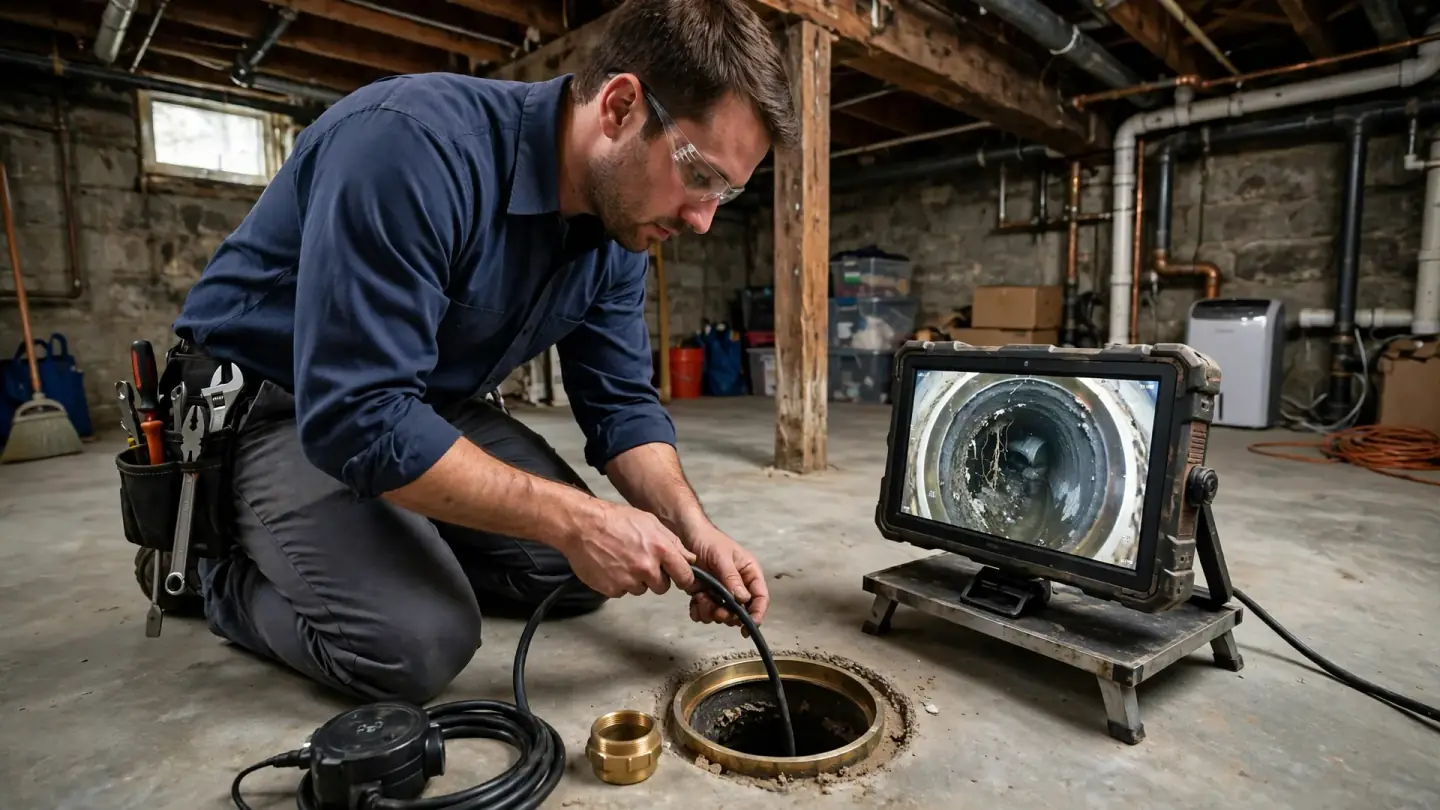
A main-line job starts with finding a way in. Older Somerville basements usually have a cleanout somewhere near where the building drain leaves the house: a threaded brass or cast-iron plug on a Y fitting, sometimes on a vertical riser by the front wall, sometimes buried behind a century of paint. Some houses have a running trap, a U-shaped fitting set into the floor with two plugs, which was common in older New England plumbing. Each gives a different line of attack, and the contractor on the call will ask what you can see before arriving.
With the cap off, a sectional cable machine is the usual tool. The cable is fed in short lengths, each coupled to the next, and spun by a motor at the basement end. A cutting head at the far end bores through whatever has narrowed the pipe: a mat of paper and wipes, a grease plug, scale built up inside old cast iron, or a ball of roots growing through a clay joint. Once the head breaks through, the backed-up water drains, and the cable is worked back and forth to widen the opening rather than leave a pinhole.
Cable work clears a path. It does not wash the pipe wall clean. Where grease or fine roots line the inside of the lateral, water jetting may be the better follow-up; the hydro jetting page covers when that fits and when an old pipe is too fragile for it. Many contractors also run a camera after cleaning, so you know whether the stoppage came from debris or from a pipe that has sagged, cracked or separated.
The cleaning stops at the city's sewer in the street. Where private responsibility for the lateral ends on your particular street is a question for the city's Water and Sewer Department, not something to guess at.
Main line or one fixture?
How do I know if my main sewer line is clogged?
A single slow sink is a fixture problem. These patterns usually point further down.
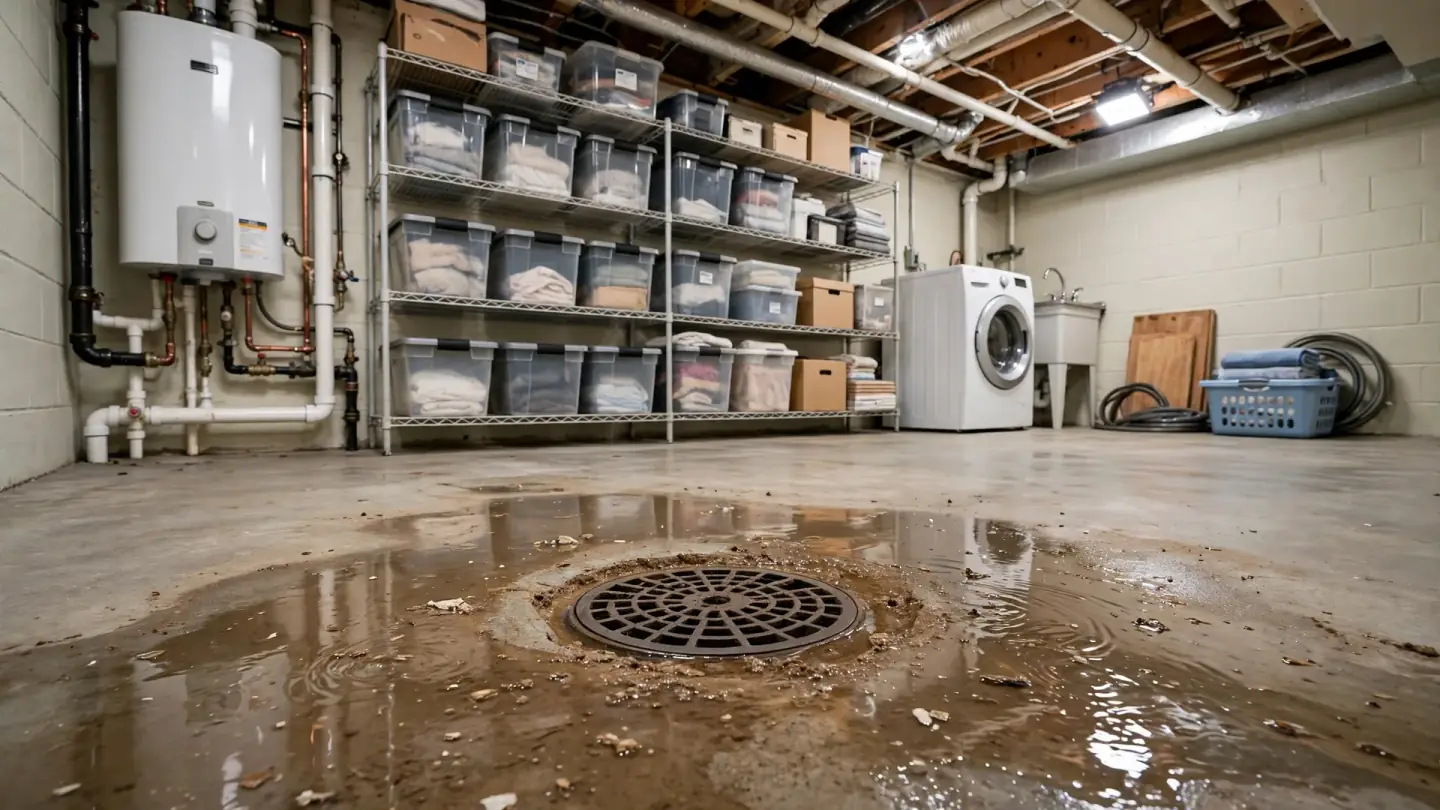
Basement floor drain fills when upstairs drains run
The floor drain is usually the lowest opening on the building drain. The guide on a basement floor drain backing up explains why it acts as the first warning.
Read moreSeveral fixtures slow on more than one floor
When the kitchen on the third floor and the tub on the first both drain slowly, the restriction is below where their lines meet.
Read moreBackups that return every few months
Cleared, fine for a season, then back. That rhythm often fits roots regrowing in a clay lateral. See tree roots in clay sewer laterals.
Read moreA sewer smell that lingers in the cellar
Standing waste in a partly blocked building drain gives off gas. It can also be a dry trap or a loose cleanout plug.
Read more

The visit
Step by step through a Somerville building drain and lateral cleaning
- 1
Finding and opening a usable cleanout
The contractor locates the cleanout or running trap nearest the foundation wall. Old plugs can be seized; if one cannot be removed without damage, pulling a toilet on the first floor sometimes gives an alternate entry.
- 2
Letting the backed-up water drain under control
If the line is full, opening a cleanout releases it into the basement. A careful contractor sets up buckets and a wet vacuum and opens the plug slowly so the water does not surge across the floor.
- 3
Running the cable out toward the street
Sections are added until the head reaches the stoppage and then the city connection. The contractor notes the distance where the cable met resistance, which hints at whether the trouble is under the house or under the yard.
- 4
Reading what comes back on the head
Paper and wipes suggest use habits; grease suggests the kitchen line; fine white roots suggest a clay joint letting them in; rust flakes suggest scale inside old cast iron.
- 5
Test-running water through the whole house
Several fixtures are run together, and the floor drain is watched. A clean main line takes a full tub draining and a toilet flush without the floor drain rising.
- 6
Recommending a camera look when the pattern repeats
For a first backup with an obvious cause, cleaning may be the end of it. For a repeat, a sewer line inspection shows what the cable could only feel.
What is in the line
What usually blocks a Somerville main sewer line and how it gets cleared
| What is found | Typical clue | Usual first approach | Likely follow-up |
|---|---|---|---|
| Paper and wipes | Fibrous mat on the cable head | Sectional cable with a cutting head | Talk about what goes in the toilets |
| Kitchen grease | Grey, waxy residue | Cable to open, then water jetting if the pipe allows | Change kitchen habits; recheck in a year |
| Roots at clay joints | Fine hairlike roots, returning backups | Root-cutting head on a sectional cable | Camera to locate joints; discuss repair |
| Scale inside cast iron | Rust flakes, rough cable feel | Cable with a descaling head, used gently | Camera to judge remaining wall |
| Broken or sagging pipe | Cable stops at the same spot, mud or stones return | Cleaning gives only short relief | Repair by a licensed plumber under permit |
Your part
What should I check before calling about a main sewer line?
A few checks help the contractor and keep a backup from getting worse. Opening a full sewer cleanout yourself is not one of them.
- Stop water use in the whole buildingTell other units, hold off on laundry and showers, and do not keep flushing. Every gallon sent down has nowhere to go but the basement.
- Note which fixtures are affected and on which floorsThis is the most useful thing you can tell the contractor. It narrows the stoppage to the stack, the building drain or the lateral.
- Find the cleanout and clear the area around itMove stored boxes away from the cleanout and the floor drain. If you cannot find a cleanout, say so on the call.
- Look out at the street during heavy rainIf water is pooling over catch basins and several neighbors have trouble, the city line may be surcharged. That is a 311 call, not a private cleaning.
- Leave a full cleanout plug aloneOpening a cleanout with a full line behind it can release sewage with real force. Let the person with the buckets, vacuum and cable do it.
- Skip the store-bought root killer during a backupChemicals poured into a stopped line just sit on top of the clog and make the pipe less pleasant to work on.
City sewer context
Somerville's combined sewers, Deer Island and the 311 call
Somerville's sewers were laid in the late 1800s and early 1900s, and across most of the city they are combined: the same pipes carry what leaves your house and the rain that runs off the street [1]. On an ordinary day that flow travels through MWRA connections to the Deer Island Treatment Plant in Boston Harbor [5]. In a heavy storm the combined system can fill, and the city's long-term plan includes storage at Assembly Square and sewer separation in Ten Hills and Winter Hill to reduce overflows [1].
Why that matters in your basement: a building drain connected to a full combined sewer may have nowhere to discharge during a downpour, even if your own pipe is clean. If your backups line up with heavy rain and not with laundry day, call 311 and report it. The city's Water and Sewer Department responds to sewer backup calls and maintains the city sewers and catch basins [3]. Callers outside the city can reach the same line through the number listed on the city's website. A private contractor can clean your lateral, but cannot fix a surcharged street main.
Two rules apply when cleaning turns into repair. Massachusetts plumbing regulations exempt the clearing of a stoppage from a permit, but cutting in a new cleanout, adding a backwater valve, or replacing a section of lateral is plumbing work for a licensed plumber under a permit from Somerville's plumbing inspector [4]. And if any of that work means digging in the yard, the state Dig Safe law requires the area to be marked in white and 811 called at least 72 business hours ahead, even on private land [6].
Clean it or fix it
When main sewer cleaning is enough and when the lateral needs repair
Cleaning is usually enough when the stoppage came from something that went into the line rather than something wrong with the line. A wipes clog, a grease plug after the holidays, or a single root intrusion in a lateral that otherwise looks sound will often stay clear for a long while once removed, especially if habits change.
Repair starts to make sense when the same spot keeps closing. Roots that return within months at the same joint, a cable that keeps bringing back soil or bits of clay, or a camera view showing a belly where water sits are all signs the pipe itself has failed. Cleaning in that situation buys time and is worth doing while a repair is planned, but it is not a fix.
If sewage is coming up through the floor drain right now, the emergency sewer line cleaning page explains what to do first; call to check emergency availability and ask on the phone whether a contractor can get there tonight. For regular upkeep on a line with known roots, scheduled preventative drain maintenance keeps the cleaning ahead of the backups.
Main line questions
Questions about main sewer line cleaning in Somerville
How do I know whether the problem is my lateral or the city sewer?
If neighbors are having trouble too, or backups happen only in heavy rain, suspect the city line and call 311. If it is just your building and it happens on dry days, the stoppage is most likely in your building drain or lateral.
My old basement has no obvious cleanout. Can the main still be cleaned?
Usually, yes. The contractor may work through a running trap in the floor, a roof vent, or a pulled first-floor toilet. Some owners later have a proper cleanout added, which is permit work for a licensed plumber. Clear stored items away from the likely exit point before the visit.
Will main sewer line cleaning in Somerville get rid of roots for good?
No. Cutting removes the roots inside the pipe, but the opening they came through is still there. They tend to regrow, which is why many owners with clay laterals schedule regular cleaning or plan a repair. Roots usually return, so a sewer line inspection helps plan cleaning or repair.
Does every unit in a triple-decker need to be home for the cleaning?
Not home, but aware. Everyone should hold off on water use while the line is open, and it helps if someone upstairs can run fixtures afterward so the contractor can watch the basement. Someone should be able to let the contractor into the basement and keep units from running water.
Is it safe to keep using the toilets after the main line backs up?
Not until the line is cleared. Anything flushed has to go somewhere, and with the main blocked that is the basement floor drain or the lowest toilet in the building. Stop flushing until the line is cleared, because waste will come up at the lowest fixture.
How often should a main sewer line be cleaned?
Many lines never need routine cleaning; others with roots or sags need it on a schedule. The right interval comes from history and a camera look, not a fixed rule. If backups keep returning, ask about preventative maintenance and see the tree roots guide.
What is a sewer cleanout and where is it in an old basement?
A cleanout is a capped opening that gives access to the building drain. In older Somerville basements it is often near where the pipe leaves through the foundation wall, sometimes as a running trap in the floor. Keep it reachable so a contractor can get to it. The services hub lists related work.