Key facts: Emergency Clogged Drain Service
- Fixtures in a house connect through a drain-waste-vent network, so a single blockage where branches join can stop several drains at once [1].
- A plumber's snake fed from a cleanout can reach shared lines that a fixture trap cannot [2].
- Somerville's Water and Sewer Department responds to sewer backups reported by residents through 311 [3].
- Snaking a stoppage needs no Massachusetts plumbing permit; cutting in a new cleanout does [4].
Branches and trunks
Why do all my drains clog at the same time?
Picture the drains in your house as a tree turned upside down. Each sink, tub and toilet has its own small pipe, those join into branch lines, the branches feed a vertical stack, and the stack drops into the building drain that leaves through the basement wall toward the street [1]. A clog sits at one point in that tree. Every fixture above that point loses its way out; everything below it keeps working.
That is why the pattern of which fixtures stopped is so useful. If the bathroom sink and tub are slow but the toilet beside them flushes fine, the blockage is probably in the short branch the sink and tub share. If every fixture on the second floor is slow but the first floor is fine, look at the stack between them. If the lowest drains in the building are the ones filling up, the clog is at or below the base of the stack, which usually means the main building drain or the lateral.
Reading the pattern
Which stopped Somerville fixtures point to which blocked line
Use this to narrow it down before you call. It is a starting point, not a diagnosis.
| Fixtures affected | Likely blockage location | Where it is usually cleared from |
|---|---|---|
| Bathroom sink and tub, same room | Shared bathroom branch | Tub drain or the branch near the stack |
| Kitchen sink and dishwasher | Kitchen branch, often grease | Under the sink, past the trap |
| Kitchen sink and laundry together | Lower part of a shared branch | Branch cleanout or the stack base |
| All fixtures on one upper floor | Stack between floors | Roof vent or a stack cleanout |
| Basement floor drain plus first-floor toilet | Building drain or lateral | Basement cleanout on the main |
| Every fixture in the building | Main line to the street | Basement cleanout, sometimes outside |
If you have a basement cleanout and know where it is, mention it on the call. It changes how the job is approached.
Holding the line
What to do while multiple Somerville drains are backed up
With several fixtures down, your aim is to stop adding water and keep people safe from what has already come up.
- Put every fixture on pauseTurn off the dishwasher and washing machine mid-cycle if needed. Ask everyone at home not to flush or run taps until the line is open.
- Message the neighbors sharing the stackIn a two-family or triple-decker, the people upstairs cannot see your basement. A short note saying the main is blocked and asking them to hold off on water use matters more than anything else you do tonight.
- Close the valve on anything still fillingA toilet tank or a running fixture can keep adding water. Shut its supply valve, or close the main near the water meter if you cannot find the individual one.
- Stay out of water that may be sewageAssume anything coming up from a floor drain is contaminated. Keep children and pets away, and wear gloves and boots if you must move belongings.
- Keep standing water away from powerIf water is spreading toward outlets, cords or an appliance, do not touch them while standing in it. Turn off that circuit at the panel only if you can reach it from dry ground.
- Do not stack chemical productsPouring openers into three drains at once just leaves three pipes full of caustic water. Different products can also react badly with one another.
Call now or later
Does a multi-drain clog in Somerville need help tonight?
If the only working toilet in the household is among the stopped fixtures, or if any water is coming up through a floor drain, it is worth calling tonight. The same goes for a building where other units cannot use their bathrooms. A clog in a shared line affects everyone feeding it, and a polite request to stop using water only holds for so long.
If two fixtures in one room are slow but still draining, and nothing is overflowing, it is usually reasonable to stop using them and book a regular visit. A partial branch clog rarely gets dramatically worse overnight if nobody is sending water into it. Describe the situation on the call and ask whether it can wait; a straight answer is part of the conversation.
Weather matters too. If several drains backed up during a heavy storm and the street has standing water, the city's combined sewer may be the issue rather than a clog in your house. Report it to 311 so the Water and Sewer Department knows [3], and call a contractor if the drains stay stopped once the rain eases.
On site
How an urgent visit for several stopped Somerville drains usually unfolds
- 1
Walking every floor with the occupants
The contractor checks which fixtures hold water and which drain, upstairs and down, to place the clog in the tree before choosing an access point.
- 2
Choosing the opening closest to the blockage
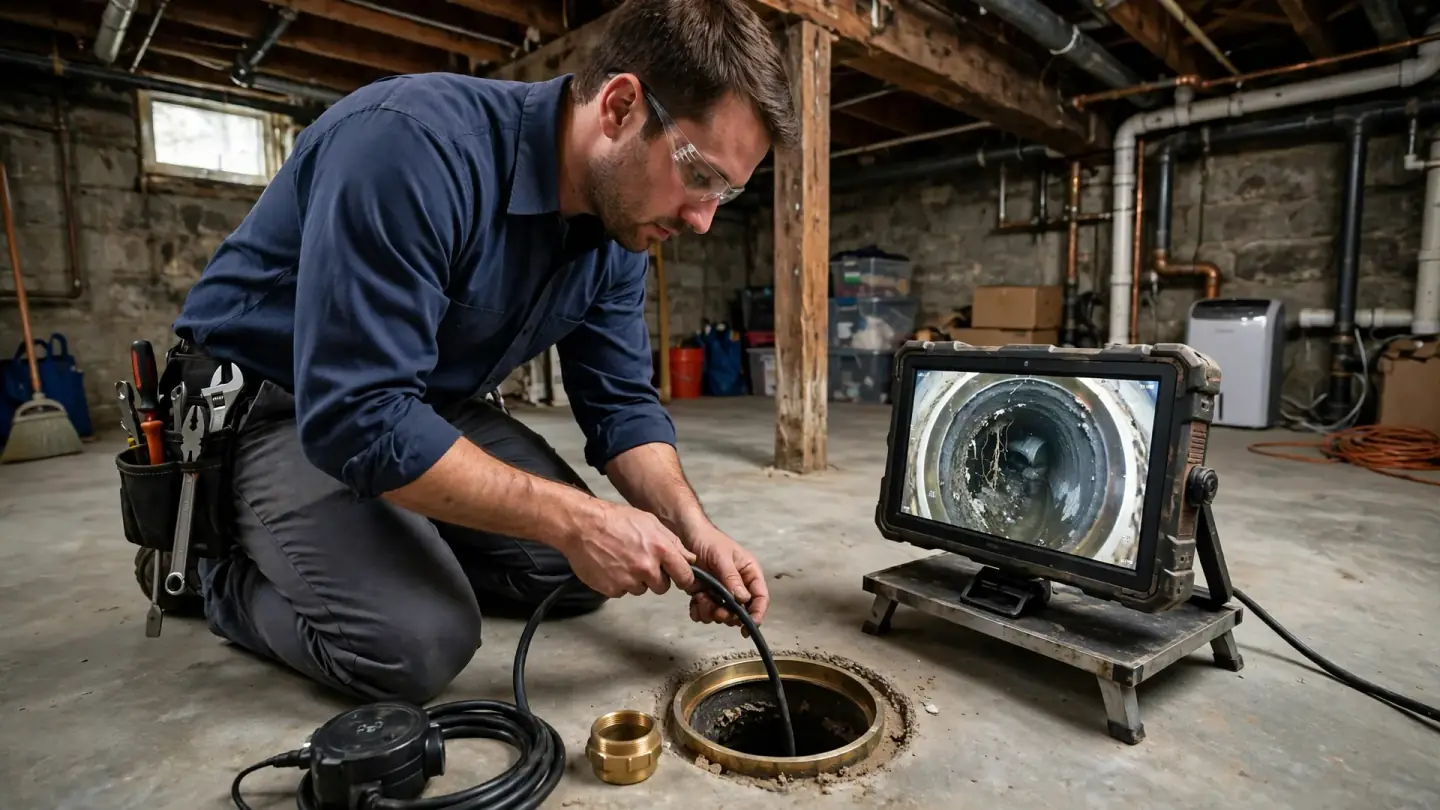
For a shared branch, that might be a tub drain or a branch cleanout. For the main, it is the cleanout on the building drain in the basement [2].
- 3
Draining off standing water safely
When a cleanout cap is removed above a full line, water rushes out. Buckets, a wet vacuum and a slow, controlled opening keep it from flooding the basement further.
- 4
Running the cable and pulling back debris
The machine is run until the line takes water. Whatever returns on the head gets a look, because grease, wipes, roots and scale each lead to different follow-up advice.
- 5
Testing every fixture that was stopped
Each one is run in turn, and the upstairs units are asked to flush and drain so the line is proven under a real load.
Several drains down
Several drains stopped at once: Somerville questions
If my sink and tub are both slow, do I have two clogs?
Probably not; two slow fixtures usually share one blockage further down where their pipes join. Plunging each fixture separately rarely helps, because the plug sits beyond both traps. A contractor will look for the lowest point where the branches meet, often the stack or the building drain, and clear from there. If the toilet is also slow, the main line is a strong suspect, as the clogged drain repair page explains.
Why does the basement floor drain fill when someone upstairs showers?
That means the building drain or lateral below the floor drain is blocked, so upstairs water rises out of the lowest opening. The floor drain is usually the lowest point in the house, which makes it the first place a main-line clog shows. Ask everyone to stop using water and call about main sewer line cleaning. The basement floor drain guide covers storm-related causes too.
Can a drain contractor clear the main line without a cleanout?
Often yes, by pulling a toilet and running a cable through the toilet flange, or through a roof vent in some buildings. A cleanout makes the work quicker and cleaner, so tell the contractor if you know where yours is. If there is no usable access, they may recommend adding a cleanout later, which in Massachusetts is permit work for a licensed plumber rather than simple clearing.
Should I warn the other units when every drain in the building stops?
Yes, tell them right away, because water they run will come out in the lowest unit or the cellar. In a shared building one tenant's dishwasher can flood someone else's floor. Ask everyone to hold off on showers, laundry and dishes until the line is cleared. The triple-decker shared stack guide explains how those stacked drains connect.
Who can unclog every drain in my house today?
A local drain contractor with a cable machine or jetter can, and calling this line connects you with one so you can check emergency availability. Availability varies by time of day. Explain that several fixtures stopped together, because that tells them to bring equipment for the main line. If sewage is coming up in the basement, see emergency sewer line cleaning.
Is it normal for the toilet to bubble when the washing machine drains?
It is a common sign of a partial blockage in the shared drain, not something to ignore. The washer pushes a large volume of water down the line, and when it cannot pass freely, air is forced back up through the toilet. Stop running the washer and watch for water rising anywhere. The gurgling drains guide explains what the sound means.
How long does it take to clear a main drain clog?
Many main-line clogs are cleared within one visit, but the time depends on access, the cause and the pipe's condition. Roots, heavy grease or a collapsed section take longer, and a camera inspection may follow to see what caused it. The contractor you are connected with can give a better idea once they see the job. For urgent help with other fixtures, see the services hub or emergency drain cleaning.