
Key facts: Tree roots in clay sewer laterals
- Vitrified clay pipe has been used for sewers for a very long time; older installations rely on joints between short sections [1].
- Roots in sewer lines are one of the blockages the EPA lists as causes of sanitary sewer backups [2].
- Massachusetts Dig Safe requires calling 811 at least 72 business hours before any excavation, even on private property [3].
- Cutting roots is clearing a stoppage; replacing lateral pipe is permitted work for a licensed plumber [4].
Short answer
How do tree roots get inside a clay sewer pipe?
Older clay laterals were laid as short lengths of vitrified clay pipe, with joints packed with mortar or a compound that has had decades to crack and shrink [1]. Warm, moist air and a trickle of water seep out of those gaps, and nearby roots grow toward them. A hair-thin root enters a joint, finds steady water and nutrients, and branches into a dense mat that catches paper and grease.
The result is a lateral that drains slowly, clears for a while after cleaning, and then slows again. Roots are a well-known cause of sewer blockages and basement backups [2]. The usual remedy is mechanical: cut the roots with a cable and cutting head through main sewer line cleaning, then put a camera through to see how many joints are affected.
Root symptoms
Signs of root intrusion in a clay lateral and what each suggests
| What you see | Likely cause | What to do |
|---|---|---|
| Whole house drains slow down gradually over weeks | Root mass growing at one or more joints | Arrange a root cutting and a camera look |
| Line backs up again months after being cleared | Roots regrowing from the same joint | Ask about scheduled cutting or a lasting repair |
| Cellar floor drain gurgles when the toilet flushes | Partial blockage restricting air and water | Stop heavy water use and call for clearing |
| Fine root threads appear when a cleanout is opened | Active root intrusion in the lateral | Leave the threads for the contractor to see |
| A soft, sunken patch over the lateral's path in the yard | Possible broken or separated clay section | Mention it; a camera locates the break |
Safe checks
What a homeowner can safely notice about a rooted lateral
- Look at the lawn and sidewalk lineNote any large trees near the path from your front wall to the street. You do not need to know the species, just roughly where they stand.
- Track how often it slowsJot down dates when the house drains got sluggish. A pattern that repeats every few months is typical of roots regrowing.
- Spot a wet cellar floor drainIf the floor drain gets damp when a lot of water runs upstairs, the restriction is on the main line, where roots live.
- Skip root-killing products until you know morePouring something down a blocked line will sit on top of the clog. Have the line opened and looked at first.
Cause one
Aging joints in Somerville's clay sewer pipe
Clay pipe resists the chemicals in wastewater well, which is why it lasted so long in so many older cities. The joints are another story. Mortar joints crumble, ground movement shifts sections slightly out of line, and frost cycles in a New England winter work at any gap. Once a joint is open even a little, roots and soil can both work their way in.
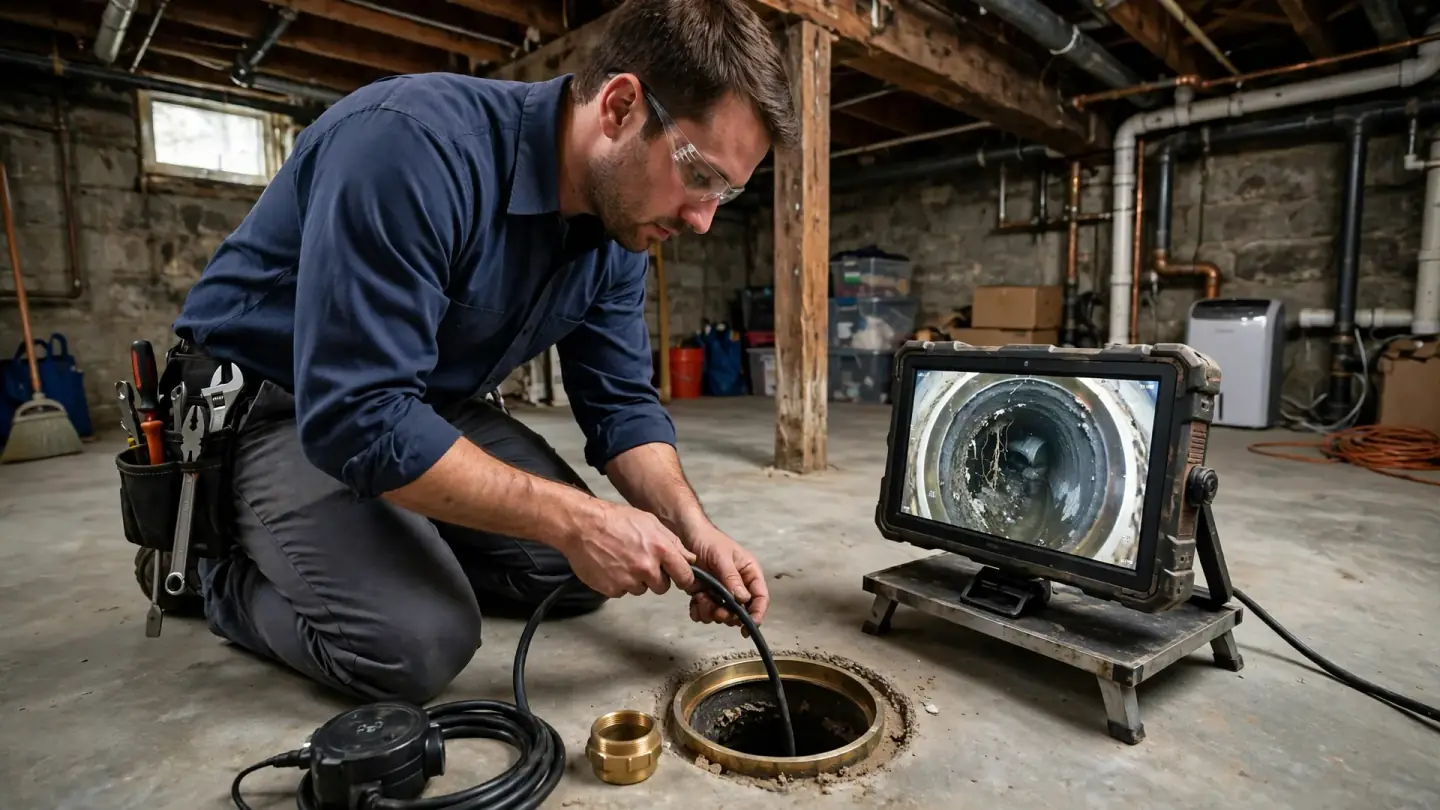
On a camera screen, an offset joint looks like a step in the pipe wall, and a rooted one looks like a curtain of fibers. The camera's footage, recorded during a sewer line inspection, gives a distance from the cleanout so any future digging or lining can be targeted.
Cause two
Why a lateral under a narrow Somerville lot attracts roots
Somerville is one of the most densely built places in New England [5], with houses close together, and many streets have trees growing in narrow sidewalk strips. The lateral from a two-family or triple-decker often passes right under that strip. A tree there has limited room to spread, and a leaking sewer joint is an attractive source of water in a dry summer.
Where the private lateral ends and the city's responsibility begins varies, so ask the city's Water and Sewer Department where private responsibility ends on your street before assuming either way [6].
Cause three
Grease and paper riding on the root mat
Roots alone rarely stop a line completely. What finishes the job is everything that snags on them: toilet paper, wipes, and grease from the kitchen. Each layer gives the next one something to cling to, which is why a rooted lateral often fails right after a holiday meal or a houseful of guests.
Diagnosis
How a contractor confirms roots in the lateral
- 1
Talking through the history
The contractor asks how long the line has been slowing, whether it has been cut before, and whether large trees stand near the front of the property.
- 2
Cutting from the main cleanout
A cable with a root-cutting blade is run from the cellar cleanout out toward the street until flow returns.
- 3
Reading the cutter
Root fibers wrapped around the blade confirm the cause and give a rough idea how far out the intrusion is.
- 4
Flushing the clay walls
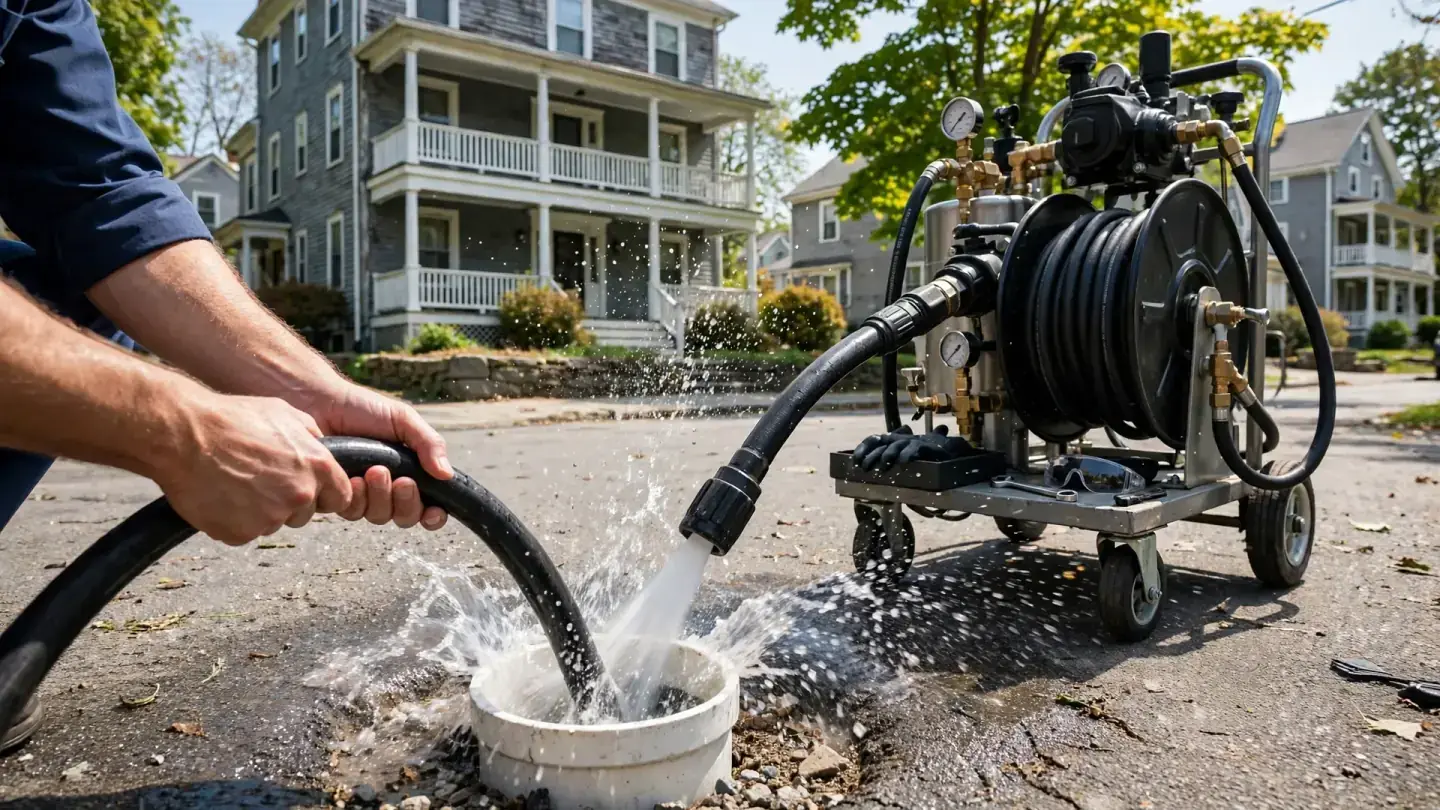
Many contractors follow with hydro jetting to wash out fine roots and grease so the joints can be seen clearly.
- 5
Recording the camera run
A drain camera inspection maps each rooted or offset joint and its distance, which shapes the next decision.
Cleaning or repair
Should I keep cutting roots or fix the clay joint for good?
Cutting roots restores flow, and because it is the clearance of a stoppage it does not need a plumbing permit in Massachusetts [4]. Roots will usually return, though, because the open joint is still there. Some owners choose scheduled cutting as a maintenance routine.
A lasting fix means sealing or replacing the damaged section, through lining or excavation. That is plumbing work for a licensed plumber under a permit [4], and any digging, even in your own yard, requires pre-marking the area in white and calling 811 at least 72 business hours ahead [3]. Ask the contractor on the call which options they handle and which they refer out.
Prevention
Slowing root regrowth in an older clay sewer line
- Keep a log of each cutting and the camera findings so you can see whether the interval is shrinking.
- Avoid planting new trees or large shrubs directly over the lateral's path.
- Keep grease and wipes out of the drains, since they turn a small root mat into a full blockage.
- Ask about a schedule through preventative drain maintenance if roots return reliably.
- Before any landscaping that involves digging near the front of the house, call Dig Safe first.
On the call
What to mention when roots may be in your lateral
- When the line was last cleared and whether roots came back on the cutter.
- Any camera footage or notes from a previous inspection.
- Big trees near the front of the house or along the sidewalk.
- Where the main cleanout is and how easy it is to reach.
- Whether the house drains are slow right now or fully backed up.
FAQ
Tree roots in clay sewer laterals: homeowner questions
How do roots get into a sewer pipe that is buried several feet down?
Fine roots find the moisture and nutrients leaking from small gaps at clay pipe joints, then grow inside through those gaps. Clay laterals are made of short sections, so there are many joints along the run. Once inside, roots thicken and branch into a mat. Trees near the line, even a neighbor's, can be the source. A sewer line inspection shows where they entered.
Will cutting the roots solve the problem permanently?
No, cutting clears the pipe for now, but roots usually grow back through the same joint within months to a few years. How fast depends on the tree, the season and the size of the gap. Regular cutting can keep a line working, but repairing the joint, lining the pipe or replacing the section stops them coming back. A camera shows which option makes sense.
Is it the city's tree or my problem?
Roots inside your lateral are usually the owner's problem, even if they come from a street tree. In most cities the property owner is responsible for the lateral from the house to the public main. Somerville's water and sewer department can confirm responsibility for your address. Ask before removing or cutting back any city-owned tree.
Do I need to call Dig Safe for a sewer repair?
Yes, if a repair involves excavation, the contractor must notify Dig Safe so buried utilities can be marked first. In Massachusetts, anyone digging is required to do this before starting. Clearing roots with a cable or jetter needs no digging and no Dig Safe notice. Ask the contractor who will arrange the notice and any permit if a repair becomes necessary.
Can hydro jetting damage an old clay lateral?
It can damage clay that is already cracked, offset or broken, which is why a camera inspection should come first. Sound clay pipe usually tolerates jetting well, and a root-cutting nozzle can clear fine roots. Badly damaged sections may need a cable instead, followed by a repair. The hydro jetting page explains the method and its limits.
What are the first signs of roots in a sewer line?
Slow drains throughout the house, gurgling toilets and a basement floor drain that backs up when water is used are common early signs. The symptoms often come and go, because roots trap debris until it breaks free. Backups that return every few months are typical. The gurgling drains guide explains why air sounds often come first, and the basement floor drain guide covers backups.
How often should a root-prone sewer line be cleaned?
Often every one to two years, but the right interval depends on how quickly roots return, which a camera inspection can show. Cleaning before the line blocks is usually easier than clearing an emergency. A contractor can suggest a schedule after seeing the pipe. See main sewer line cleaning for how it is done, and the guides page for related topics.